

The dry Melbourne experienced from August to October was great for doing some remedial work on the borders. Usually early spring is much too wet
to be working volcanic soil – and any soil really! However, the lengthy dry period of late spring 2025 was ideal for tearing apart some areas that needed attention. One was where an alstroemeria had spread out metres past where it should have been, and another was a nasty tangle of asters that had become a mass of nonsense.
Each area was thoroughly forked and all plants removed in order to start again.
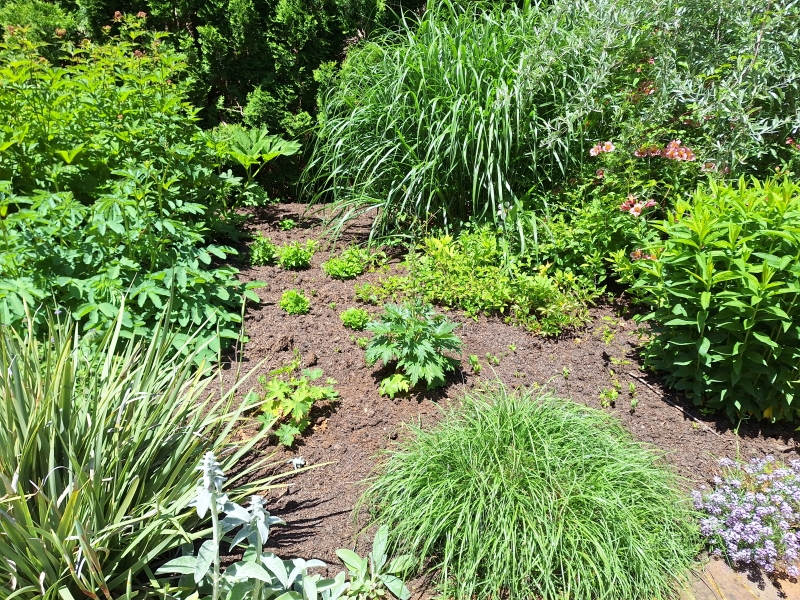
The problem here was that the very handsome soft-pink alstroemeria had encroached from the right, from under the weeping silver pear, Pyrus salicifolia ‘Pendula’. Of course I let it encroach because it was so handsome, but at some point one must put down one’s foot!
To the left of the pear, there’s an old clump of Miscanthus sinensis ‘Silberfeder’, flowering in late summer and high enough to catch the morning sun over
the hedge. Then a filipendula (an astilbe on steroids, if you like) with immense pink fairy floss flowers in January. And in front, Sanguisorba ‘Lilac Squirrel’, handsome for its blue-green leaves and its wands of pendulous pink flowers, which coincide with the filipendulas.
As for the gap in the middle, that’s to be filled with two of the taller veronicas, one with purple-blue flowers and the other white. Also Geranium ‘Patricia’,
a hybrid of G. psilostemon with crimson-purple flowers, hopefully fully flowering from February to March.
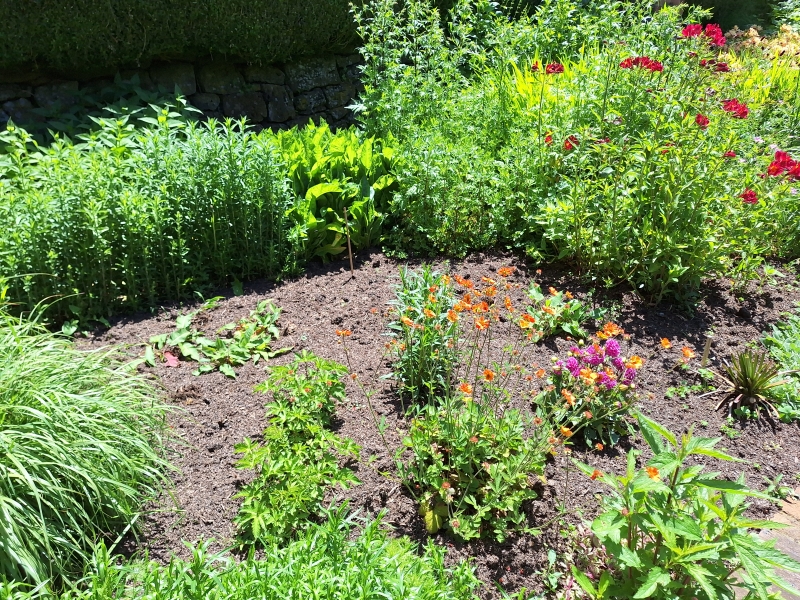
The ‘in-between image’ shows another gap where those out-of-control asters were dealt with severely. These have been replaced with a couple of clumping persicarias, a creamy-flowering dwarf aruncus (in the astilbe-filipendula family) and in the middle a strip of Penstemon ‘Alice Hindley’ with jacaranda-blue white-throated flowers for many months. My wife Valerie brought this penstemon back with her from a visit to her family in Kent years ago and it is absolutely the best penstemon ever.
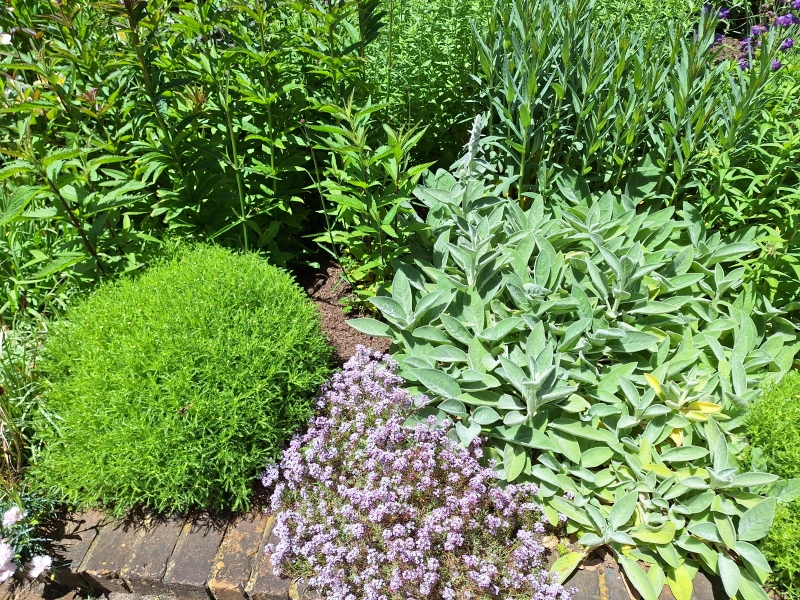
And now for one or two areas we have not touched. The ‘edges’ image above shows a tiny area of frontal planting.
To the left is Santolina ‘EA Bowles’, with creamy flowers in mid-summer. Note that we cut it almost to the ground in August to be sure it stayed a tight mound throughout the season.
To the right, there’s Stachys ‘Big Ears’, with soft-grey leaves and only the occasional flower. (Stachys that flower strongly always go to pot halfway through the season!)
And in the middle, a perennial alyssum. This, I must add, is a tremendously useful plant, flowering 10 to 12 months of the year and soundly perennial. However, you very rarely see it sold as it is identical to the annual alyssum (even to its lovely perfume) and people think it should cost 50 cents and not the $20 nurseries must charge for a difficult-to-propagate cutting-grown plant.
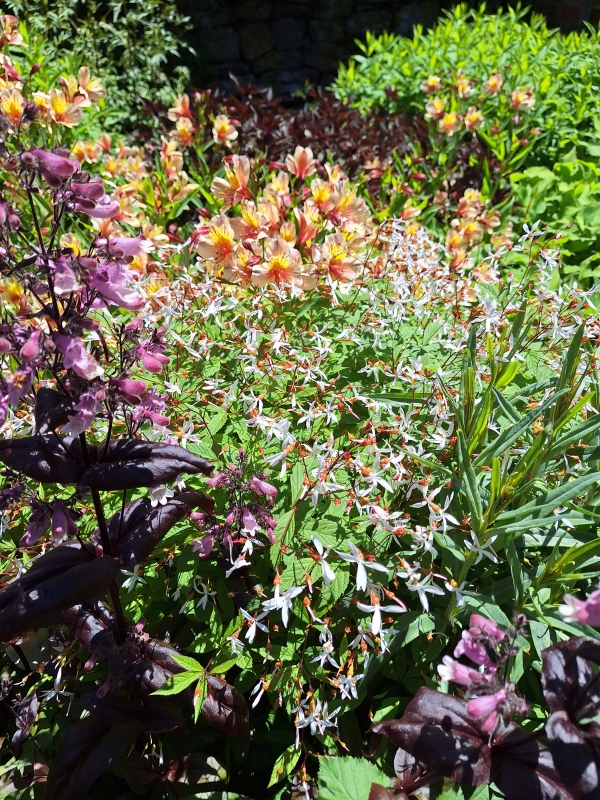
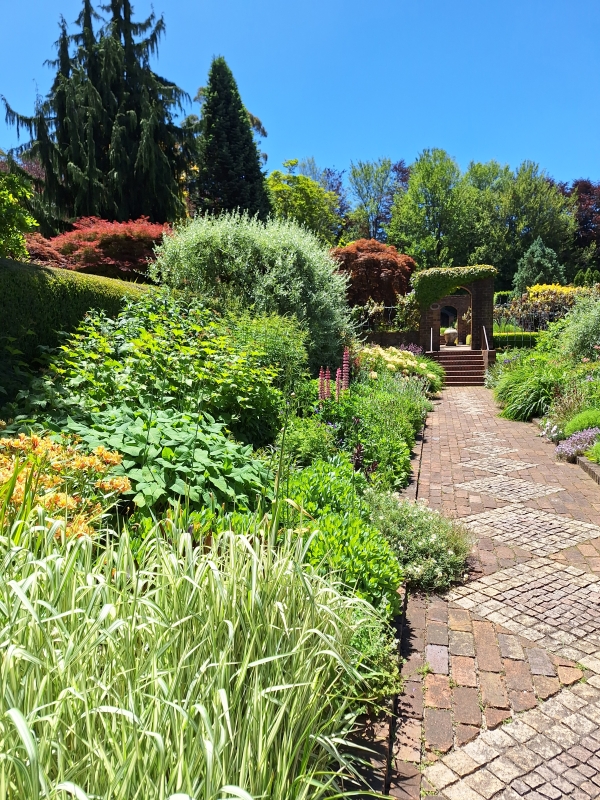
Curiously, having talked about the gaps, the cool border image above is more typical of the cool borders in early summer. Plants are bumping into one another and a lot of colour is building up. Penstemon digitalis ‘Dakota Burgundy,’ a vast improvement on the old P. digitalis complements the wispy-white flowers of the lovely Gillenia trifoliata. I have grown this plant in a shady spot for yonks, then spotted it holding its own in the middle of borders in various English gardens 18 months ago. I moved ours in September 2024; now nicely settled, I expect a lot from them this year. In mid-summer their flowers are replaced by small red berries, then in autumn the leaves turn a glowing orange-yellow.
Behind is another alstroemeria. We have some 15 varieties of this useful plant, but only the big ones. The miniatures you mostly see in nurseries are too easily swamped by their neighbours in a border. Buy the big ones growing at least one metre tall, and remember: when the flowers are finishing, pluck the old stems from the ground. Deadheading with secateurs will stop the clump flowering dead in its tracks, while hand-plucking old stems will keep it flowering for six to eight months.
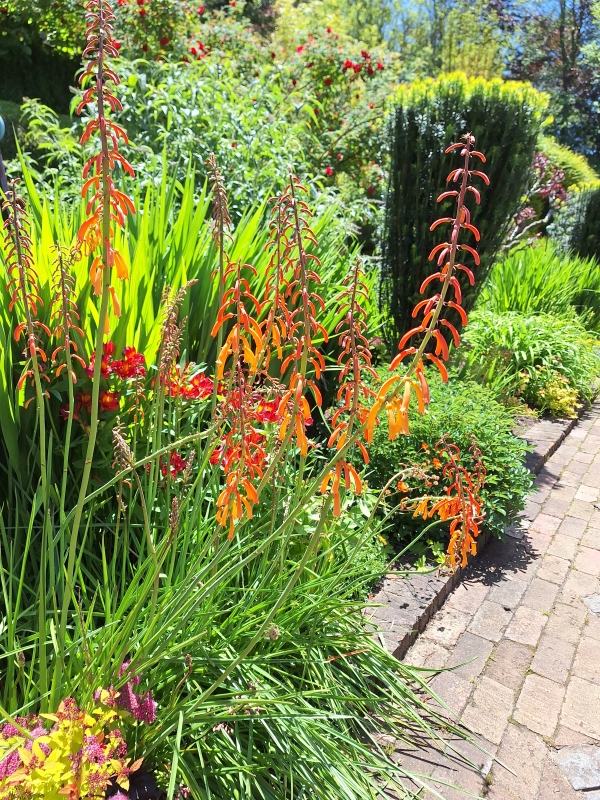
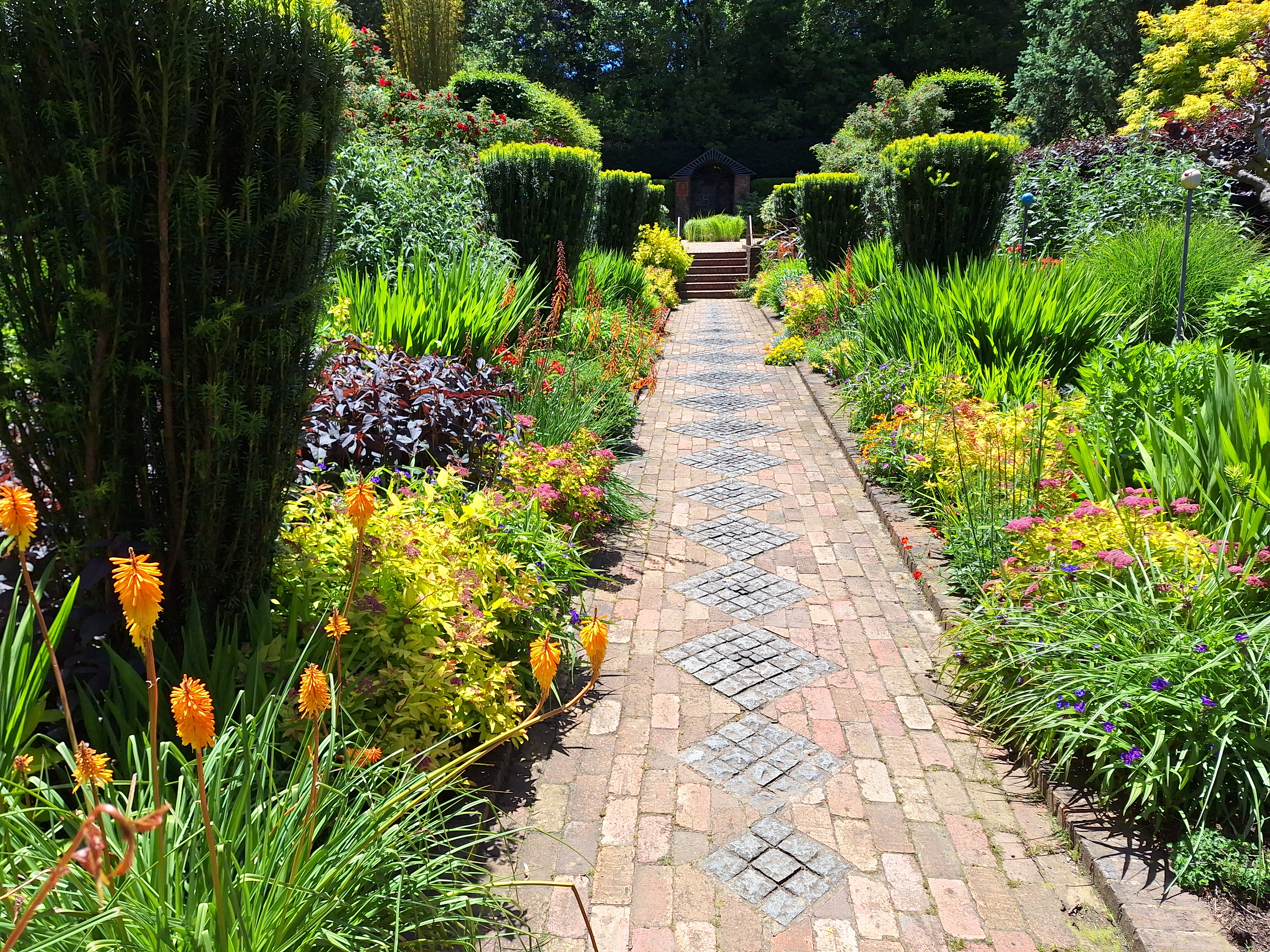
I haven’t spoken of the warm borders. Maybe next time. However, to whet your appetite, they look like this (above) early in the season.