

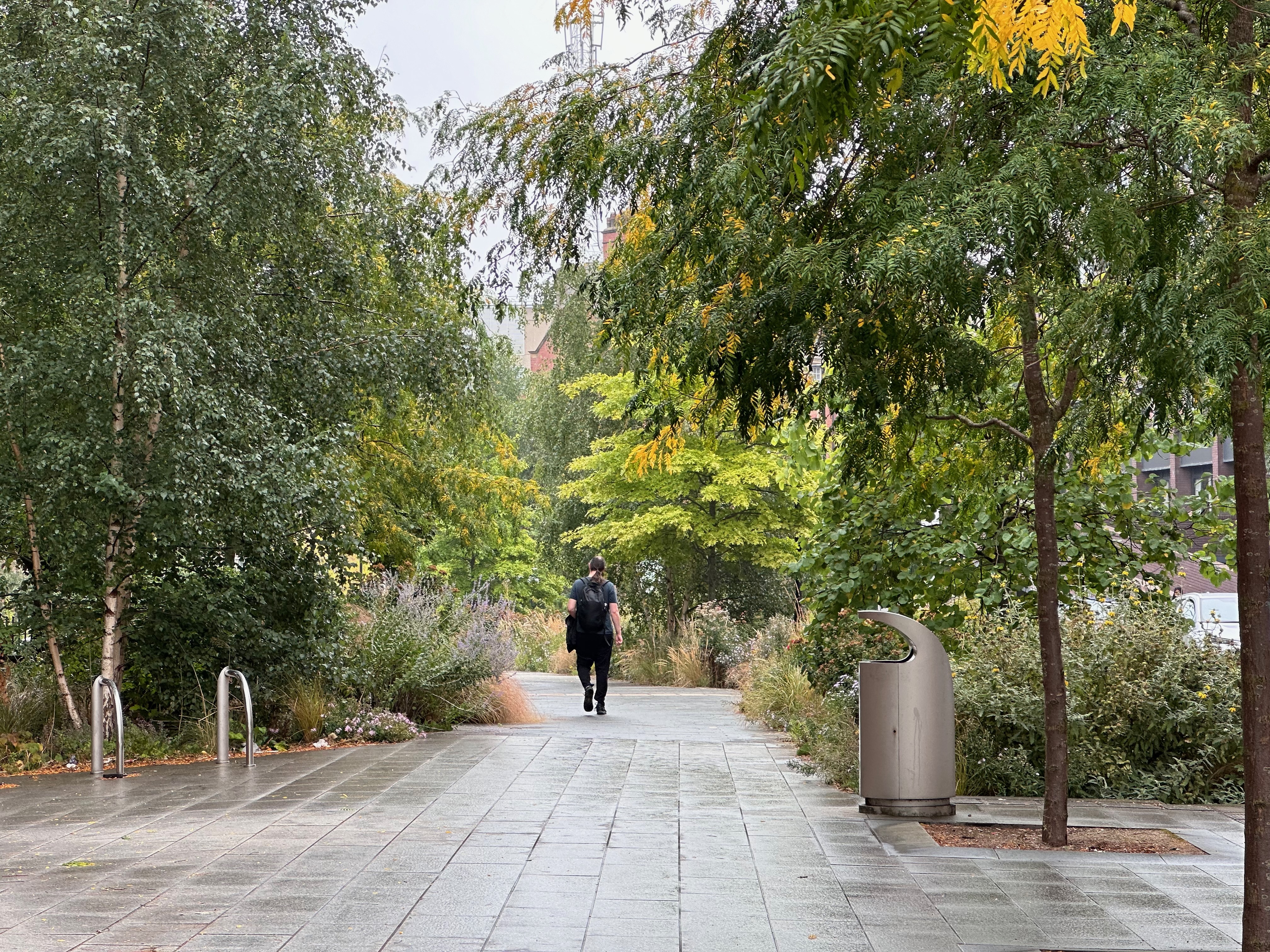
The city of Sheffield, UK – once a booming city of steelworks but in economic decline since the 80s – has been given a horticultural facelift in the last ten years.
Inner-city streets have been narrowed or entirely rerouted to allow for large areas of naturalistic planting, which all happen to function as rain gardens and bioswales that capture, filter and store runoff from roads and pavements.
Totally essential to the success of this ambitious and remarkable project was the collaboration between Professor Nigel Dunnett of Sheffield University and Zac Tudor, then Landscape Architect to the City Council. Both Nigel and Zac were involved in the development of the ‘Sheffield School’ of planting, which leans toward highly complex and integrated planting schemes, with plants chosen for similar competitive values and minimal maintenance demand. The aim of such planting is to be as beautiful as it is resilient in the face of varying water conditions, while being self-healing where occasionally necessary via processes of self-sowing.
This form of planting was largely pioneered by Prof. James Hitchmough (previously on staff at Burnley College in Melbourne, then at Sheffield University) along with Prof. Nigel Dunnett, and together they have designed many high-profile planting schemes worldwide, mostly in public areas. They have been working now for several years on the planting design for the Melbourne Arts Precinct, or Laak Boorndap.
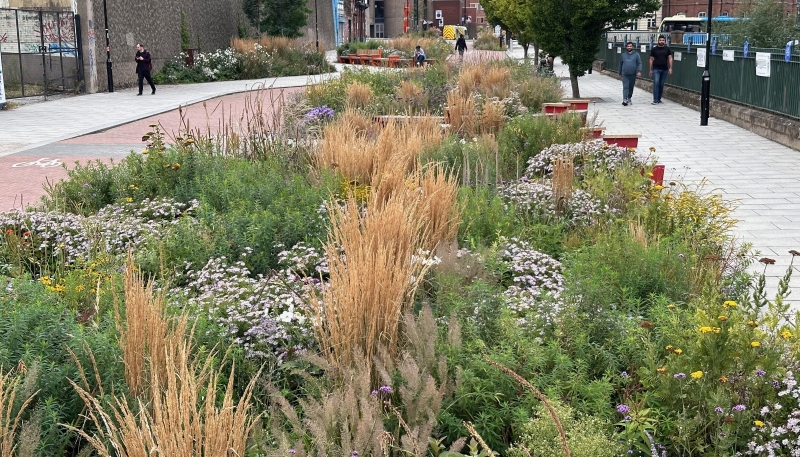
The Sheffield project, labelled ‘Grey to Green’, has been an incredible success and is well worth a visit if you’re anywhere in the vicinity. It’s a total triumph and looks like the sophisticated naturalistic planting you’d expect to see in a high-grade garden. You have to remind yourself that this is extremely practical planting, serving several prosaic engineering processes while receiving minimal maintenance.
The soil used was created entirely of recycled materials, combining locally sourced quarry waste, some loam recovered from vegetable washing, and small quantities of organic matter in the form of composted green waste. This was then ‘mulched’ with crushed rock – 20mm particles, down to fines – to a depth of 100mm, and the plants planted half into the gravel mulch and half into the soil.
In apparent opposition to much of what many of us learned about planting, the mix was deliberately low in nutrition to minimise the rate and bulk of growth and to even out the competitive values of the wide range of plants used. Both drought tolerant and water-demanding species were included to cover the widest range of possibilities. These were watered twice only during their first year of establishment and have not been watered since.
Learn more about Nigel’s contribution to the planting design for the Melbourne Arts Precinct in our free member webinar ‘Looking after Laak Boorndap’, 26 October at 7pm. See more details and register online.
The planting design process was more about creating an effective and compatible mix of plants than about their careful placement. Other than several meandering ‘rivers’ of Calamagrostis ‘Karl Foerster’, all plants were randomly placed throughout their planting zone.
The result is a remarkable succession of perennials over the growing season, with layers of flowering plants that bulk up at different times, such that earlier-flowering plants are subsumed in the growth of later-flowering species.
All perennial vegetation is cut to within 150mm of the ground in winter, with all offcuts removed from the site. Other than that, three visits by maintenance staff early in the season keep weeds at bay.
The project has been realised in phases, with Phase 1 completed in 2016 and Phase 2 largely completed in 2020, so that it now presents like a linear park, stretching over a kilometre throughout the city.
What is immediately and abundantly clear to anyone with gardening experience is that this planting, for all its apparent bullet-proof resilience, is very carefully considered and the work of designers with an intimate knowledge of plant architecture and behaviour, of how plants change through the seasons and how they interact and compete. This is very high-difficulty planting design at its very best, performing important infrastructural roles while looking like much-loved garden content.
Sheffield’s ‘Grey to Green’ project is hugely exciting and should set an inspiring standard for all such works worldwide.